Friends with benefits - Cleaning symbiosis
Have you ever wondered why so many animals live in perfect harmony
with each other?
Sometimes it is because they can rely on each other for resources.
Although the majority of symbiotic interactions occur at the microscopic level (Gilbert
et al. 2015), there are symbiotic relationships that we can appreciate
without the microscope. Some of the best known examples of these relationships
are cleaning symbiosis where one species will pick the parasites off another
for food. This is particularly common in birds and fish for example, the
cattle and egret commensalism.
 |
| Cattle egrets Bubulcus ibis with a cow (Dupont 2016) |
The cattle egret Bubulcus ibis is known to live among
various animals such as deer and cattle to pick off and eat parasites such as
ticks that may live on them (Palmer et al. 2019; Chaskda et al. 2018). Although
Egrets are not obligatory symbionts, Chaskda et al. 2018 found that egrets that
feed of flock parasites do spend less time looking for food than egrets that do
not feed off cattle even when there is an abundance of insects. These types of
commensalisms have been documented between various birds, mammals and reptiles
(Chaskda et al. 2019).
Fish are friends, not food.
Cleaning symbiosis is also common in fish such as Wrasse &
Gobies that feed off parasites from other often predatory fish. Many fish
species in the family Labridae have a evolved dark dorsal stripe indicative of
their cleaning status. Scientists believe that this may help cleaning fish
advertise their cleaning status to other fish (Arnal et al. 2006). Another
study found that the cleaning fish with a bright blue band were more successful
in attracting fish to be cleaned (Cheney et al. 2009). Some species also oscillate
to advertise their services to fish (Gingins et al.2017). However, there are
some fish that have cheated the system.
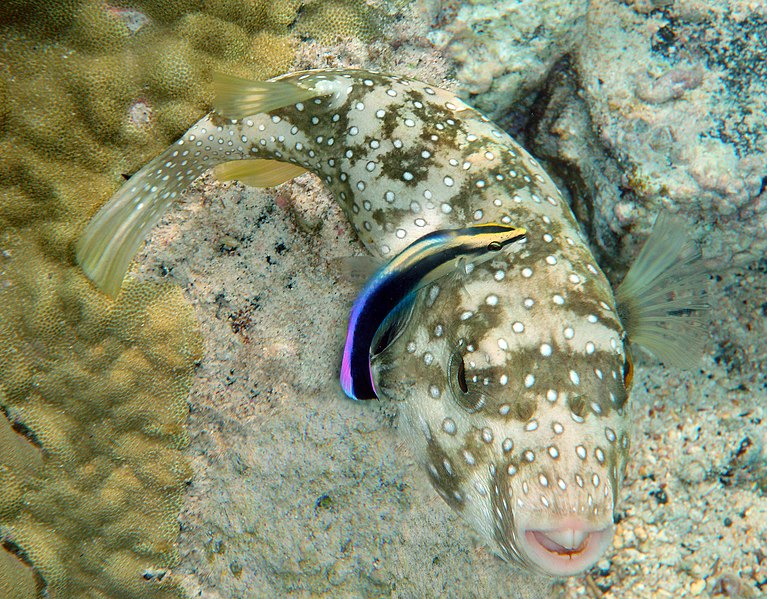 |
| A White Spotted Pufferfish Arothron hispidus being cleaned by a Hawiian Wrasse Labroides phthirophagus (Inaglory 2010) |
Too much of a good thing?
Cleaning mutualisms can sometimes turn into parasitism in the
right circumstances. Some cleaning fish will try to eat some of
their hosts instead of the parasites. As a result the client fish will chase
the cleaners to threaten them or swap partners (Gingins et al.2017).
A new discovery
A recent study found a possible mutualism for the first time
between white tailed deer Odocoileus virginianus, insectivorous bats & parasitic horse flies Tabanidae where bats were seen eating the flies (Palmer et al. 2019). This
is one the first documented symbiotic relationships with detached parasites an
opens the door for the possibility of exploring cleaning symbiosis between bats
and other animals.
For more animal examples go here: https://galapagosconservation.org.uk/symbiotic-relationships-galapagos/
Thanks for reading J
Check back next week for more....
That’s so interesting! In your example with the deer, how is this a mutualism when the bats could, theoretically, get food elsewhere?
ReplyDeleteHi Tasmin, it would be a facultative mutualism. Deer are often heavily plagued by flies so it would reduce foraging time for the bats and the deer would gain the direct benefit of reduced parasitism.
Delete